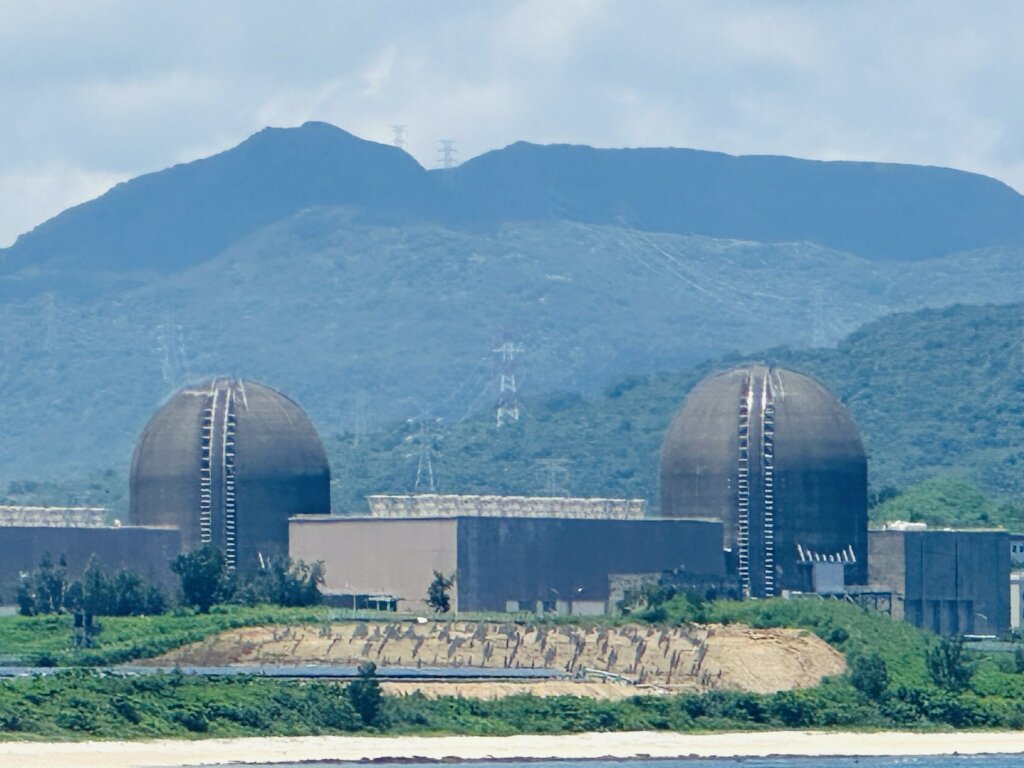
Maanshan nuclear power plant
Together with the “nine-in-one” set of nationwide local mayoral and assembly elections November 28, Taiwan citizens will have the opportunity to cast votes on the question of “Do you support the government’s use of nuclear power to revitalize the economy and revoke the ‘nuclear-free homeland’ energy policy?”
The 22nd national referendum to be held in Taiwan and the fourth aiming to revive nuclear power put forward by pro-nuclear advocates and political parties in eight years, is ill-conceived and unnecessary.
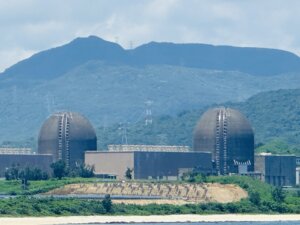
Its target is the energy transition program launched under Democratic Progressive Party (DPP) president Tsai Ing-wen after she took office in May 2016 with the backing of the DPP’s first ever parliamentary majority and specifically its policy of realizing a “nuclear free homeland” by retiring Taiwan’s nuclear power plants on schedule after 40 years of operation, with the last, the 951-megawatt Unit 2 at the Maanshan (also known as Nuclear Three) operated by the state-owned Taiwan Power Co in southernmost Pingtung County on May 17, 2025.
In August, lawmakers of the pro-nuclear opposition Chinese Nationalist Party (Kuomintang or KMT) and the smaller Taiwan People’s Party (TPP) used their current edge in the Legislative Yuan to mandate a legislative referendum against the “nuclear free homeland” policy by a 59-51 vote despite opposition by the DPP and objections raised by numerous legal and environmental groups. The Cabinet-level Central Election Commission (CEC) acquiesced to the Legislative demand to put the issue on the ballot later that month while rejecting two other topics, including a referendum proposed by the KMT to institute judicial caning as a criminal punishment.
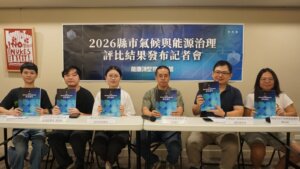
In response to the approval of the referendum by the CEC, the National Nuclear Abolition Action Platform and like-minded civil society and environmental organizations rapidly collected over 1,200 citizen endorsements to establish a “referendum opposition office” to arrange for three civil society representatives to present opposing opinions to the public in five nationally televised sessions organized by the CEC.
National Nuclear Abolition Action Platform secretary-general and “Nuclear Power Referendum” Opposition Office representative (Ms) Tsui Su-chin stated that “from the beginning, this referendum was full of political manipulations.”
Tsui stated that the KMT and TPP had enacted this Legislative referendum for the sake of politically mobilizing their supporters and charged the Taiwan public with the bill, which could exceed NT$800 million.

Ms. Tsui Su-chin submits 1,200 citizen endorsements to the Central Election Commission (CEC).
The question posed — “Do you support the government’s use of nuclear power to revitalize the economy and revoke the ‘nuclear-free homeland’ energy policy? –is the least coherent of the four nuclear-related national referenda held since 2018 and is essentially a NT$810 million public opinion poll conducted at the public’s expense.
This referendum follows a similar exercise of Taiwan’s 21st referendum mandated by the Legislative Yuan on August 23, 2025, in tandem with numerous recall votes against KMT legislators, on the question of “Do you agree that the Third Nuclear Power Plant should continue its operation, provided that the competent authority has granted its approval and confirmed that there are no safety concerns?” Although 74.2% of the 5.91 million citizens who voted in favor, the referendum failed to attain valid passage as “yes” votes totaled 21.7%, short of the 25% of the total electorate required.
Since it is not a bottom-up initiative, the referendum cannot directly revoke the legal foundations of the “nuclear free homeland” policy in the Environment Basic Act of 2003 or the Climate Change Response Act of 2023 since the Legislature has the constitutional power to revise laws directly. It also does not mention the question of whether to restart the Maanshan facility, perhaps because a KMT-TPP sponsored referendum on that topic failed in August 2025.
According to its Explanatory Note, the referendum aims to “manifest nearly 80% of Taiwan’s democratic public will” to “officially shatter the rigid bonds” of the nuclear free homeland policy and demand that the government realize the policy of promotion of nuclear power “under the supervision of the Legislative Yuan.”
Besides citing the questionable authority of Elon Musk that abandoning nuclear power plants is “total madness,” the brief claims that hiking the power share of nuclear power, presumably by large scale deployment of small modular reactors (SMRs), can resolve Taiwan’s alledged shortages of electricity for semiconductor manufacturing and artificial intelligence data centers (AIDCs) and produce water and hydrogen while lowering carbon dioxide emissions.
Since the referendum was mandated by the Legislative Yuan majority under the Referendum Act, the official election announcement and explanation distributed to every Taiwan citizen does not include the views of other concerned government agencies or other legislative caucuses as would be the case in a bottom-up initiative.

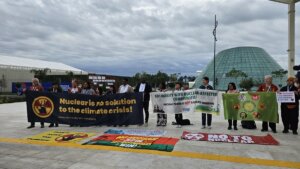
NNAAP holds a press conference outside the Legislative Yuan, announcing the establishment of a referendum opposition office to debunk nuclear power myths during televised debates.
Advocates, including KMT chairwoman Cheng Li-won and KMT Legislator Niu Hu-ting, assert that “stable, cheap and clean” nuclear power running 24 hours a day and seven days a week is essential for Taiwan’s semiconductor industry and artificial intelligence data centers and supply chain operations. During the first referendum opinion discussion session, Niu based his case on the assumption that nuclear power will cost “between “NT$1-1.5 per kilowatt-hour,” a level which characterized Taipower’s cost for nuclear power in 2024 at the end of the 40-year license when all capital investment had been depreciated and the only nominal expenditures were fuel and other operating expenses.
However, senior Taipower executives have told news media that such an expectation for a re-licensed and restarted Maanshan or Kuosheng plants are “unrealistic” given necessary investments in safety upgrades and replacements of aged components, leaving aside the questions of the inclusion of “externalized” costs.
President and DPP chairman Lai Ching-te, who took office in May 2024, had instructed Taipower to carry out “autonomous safety inspections” of the Maanshan and Kuosheng (Nuclear Two) facilities to evaluate the possibility for possible restart and the Nuclear Safety Commission (NSC) recently approved the plan submitted by Taipower for this purpose.
Hence, TPP Legislator Hung Yu-shiang stated in the fourth referendum opinion session Nov. 18 that Lai had made a “180- degree turnabout” in the DPP’s long-standing anti-nuclear position to authorize the restart of the Maanshan plant.
But the president’s position appears to be somewhat more nuanced. Presidential spokeswoman Kuo Ya-hui stated October 22 after a meeting of the National Climate Change Committee in response to news media questions on the president’s stance on the referendum that the “nuclear free homeland” policy had been jointly established by both the governing DPP and opposition parties in 2003 in the Environment Basic Act.
Kuo noted that the construction of the fourth nuclear power plant had been halted under the KMT administration of president Ma Ying-jeou in April 2014 and that, “with the final reactor unit at the third nuclear power plant (Maanshan) shut down on May 17, 2025, Taiwan has effectively achieved the goal of a nuclear free homeland.” Moreover, Kuo stated that “at present, power supplies are secure and there are no problems of electricity shortages.”
Regarding the potential use of nuclear power, Kuo stated on behalf of the president that he “approaches the issue without ideological bias and does not rule out any energy options,” but added that “environmental sustainability must not be sacrificed for the sake of short-term gains” and that “any move to restart a nuclear power plant must meet three essential conditions: guaranteed safety, a viable solution for nuclear waste, and a broad social consensus.”
Although opposition politicians point to Lai’s actions as indicating that the DPP has reversed its position on nuclear power, a survey conducted by the Taiwan Environmental Protection Union (TEPU) of DPP mayoral candidates and DPP administered cities and counties reveals virtually across-the-board support for continuing the “nuclear free homeland” policy and opposing restarts of retired reactors or construction of new nuclear facilities.
The Ministry of Economic Affairs and the Democratic Progressive Party legislative caucus expressed opposition in the five referendum opinion sessions convened by the Central Election Commission along with three civil society representatives.
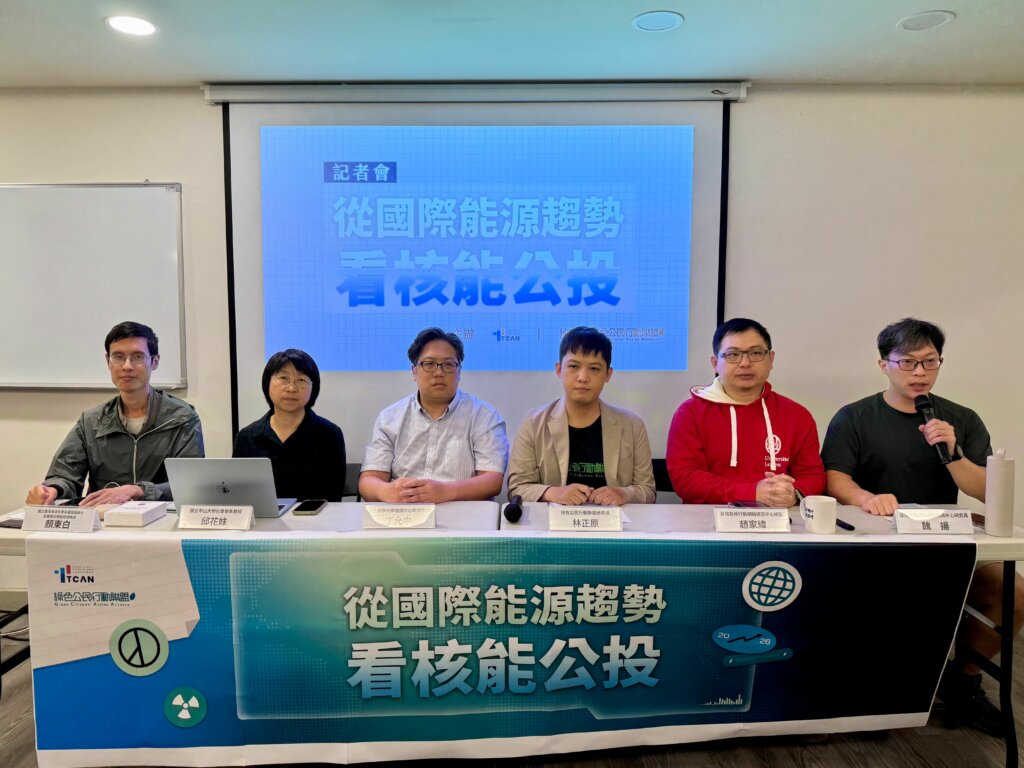
Taiwanese scholars warn that tripling nuclear power is unrealistic, citing unresolved nuclear waste and decommissioning issues, low public acceptance, Fukushima’s lasting impact, and the risk of slowing the renewable energy transition. They urge voters to vote “No” in the referendum.
DPP Legislator (Ms) Chen Pei-yu observed during the first of five CEC sessions November 12 that the referendum is “unnecessary” since the opposition parties already have the power to deliberate and have the votes to enact the revisions they desire to these statutes in the Legislature. Chen noted that if the referendum receives valid approval with “yes” votes from 25% of the electorate and more “yes” than “no” votes, lawmakers of the two opposition parties will still have to carry out these legislative procedures if they intend to carry out its mandate.
Deputy Economics Minister Lai Chien-hsin also maintained that the referendum was unnecessary during the second referendum opinion session Nov. 14.
The deputy economics minister related that even though the Maanshan-2 PWR had been retired in May 2025, the economy and exports grew briskly in 2025 and 2026, saying that Taiwan’s economy grew by 8.74% (in inflation adjusted gross domestic product ) and economic growth will top 11% in 2026, according to the Directorate-General for Budget, Accounting and Statistics.
Lai stated that nuclear power was not “a panacea to revitalize the economy” and that nuclear power had “no substantive relationship with economic development.” He stressed that generating capacity of combined cycle gas turbines (CCGTs) will be more than sufficient through 2035 to satisfy even the anticipated 2.5% annual rise in power demand, including increased demand due to the expansion of the semiconductor and AI industries, without considering the rising share of power capacity from renewable sources, such as offshore wind and solar.
Lai also observed that Taipower was currently carrying out the restart plan for Maanshan approved by the NSU September 24 in line with revisions to the Nuclear Reactor Facilities Regulation Act enacted by the opposition majority in 2025 and said that whether the facility would be used or not was a matter of “rigorous engineering and safety” and should be resolved based on law and respect for professional expertise.

An activist wearing a mask of KMT Chairperson Cheng Li-wun holds a sign reading “Nuclear Power Is Essential for AI,” while another activist crosses out the slogan with a red marker.
Representing the National Nuclear Abolition Action Platform, Citizens of the Earth Taiwan (CET) spokesperson Teng Yu-you used his time in the fifth referendum opinion expression session Nov. 20 to rebut the claims that nuclear power was linked to economic revitalization, that AI and semiconductor manufacturing industries depended on nuclear energy, that Taiwan needed to build SMRs even though such reactors would be expensive and not available until the mid – 2030s, that the only “24/7” power source was nuclear power while geothermal and combinations of solar-storage and wind-storage and microgrids combing these technologies could also supply “24/7” power, and that the European Union had endorsed nuclear as “green power” when the EU taxonomy defines both nuclear and LNG as “transitional options.”
Moreover, Taiwan Obasang Political Equality Party spokesperson Shen Pei-ting emphasized during the third session that power plants, whether fueled by nuclear or fossil fuels, only comprise part of a power system with transmission and distribution networks of equal importance. Indeed, Taipower has been making large scale investments in decentralizing the national power grid precisely because of its vulnerable over-centralization during the heyday of nuclear power operations in the 1980s and 1990s.
However, it does not appear that Taiwan Semiconductor Manufacturing Corp (TSMC) or other chip makers agree that nuclear power is essential to their global operations.
TSMC itself is pledged to utilize “100%” renewable energy in its worldwide operations by 2040 under a RE100 commitment that excludes nuclear power. Moreover, attendees at this year’s “SEMICON Taiwan” and “Energy Taiwan & Net-Zero Taiwan” exhibitions could see multiple offerings of microgrids that provided 24/7 power based on solar, wind or fuel cells with battery storage, with geothermal also being future options for solutions to the power supply needs of AI data centers.
A consequence of the fact that the official election announcement does not include responses by government agencies to the referendum proposal is that numerous examples of misinformation or disinformation in the explanation of the reasons for the referendum go uncorrected or unchallenged even though most if not all have been repeatedly rebutted.
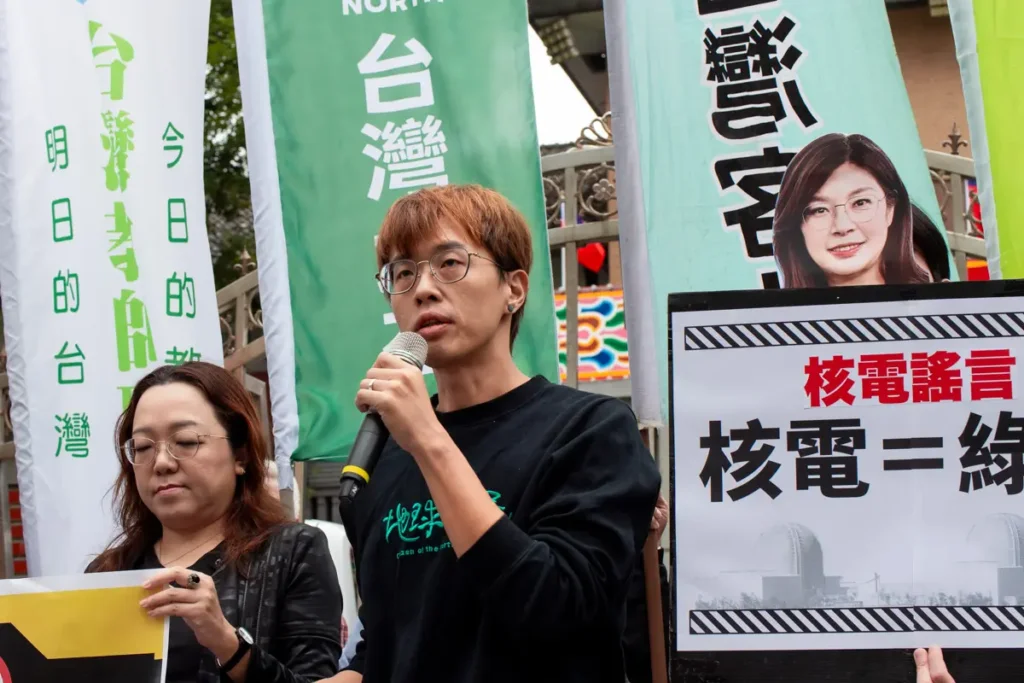
Citizens of the Earth Taiwan (CET) spokesperson Teng Yu-you
The elephant in the earth
However, the utmost issue in the decades-long struggle over the use of nuclear power in Taiwan is safety, especially given Taiwan’s high seismic risk profile.
TEPU founder Shih Hsin-min, a member of the presidential National Climate Change Committee, stated November 23 that “given our ecological, geological and social conditions, Taiwan is unable to bear the impact of any nuclear disaster. “
National Taiwan Ocean University (NTOU) Center of Excellence for Ocean Engineering (CEOE) assistant professor Wang Shou-cheng reminded citizens during the fourth set of publicly funded discussions on the referendum that the most fundamental question was that of geophysical safety, a question habitually ignored or minimized by pro-nuclear advocates.
Wang related that when Taiwan’s first three nuclear power sites were sited in the 1960s and 1970s, contemporary geophysical technology was unable to detect the diversity and severity of geophysical structures and faults.
However, Wang related that studies by the Ministry of Economic Affairs Geophysical Survey Administration and the Taiwan Power Co have shown that faults run directly under the two reactors of the Maanshan Nuclear Power Plant in Pingtung County.
The NTOU assistant professor warned if faults detected under a nuclear reactor that cannot be determined to be inactive, the reactor must be decommissioned.
In July 2024, Japan’s Nuclear Regulation Authority rejected the application of the Japan Atomic Power Corporation (JAPC) to restart Unit 2 of its Tsuruga Nuclear Power Plant in Fukui Prefecture on the grounds that JAPC was unable to prove that there were not active faults under the 1,116-megawatt pressurized water reactor (PWR).
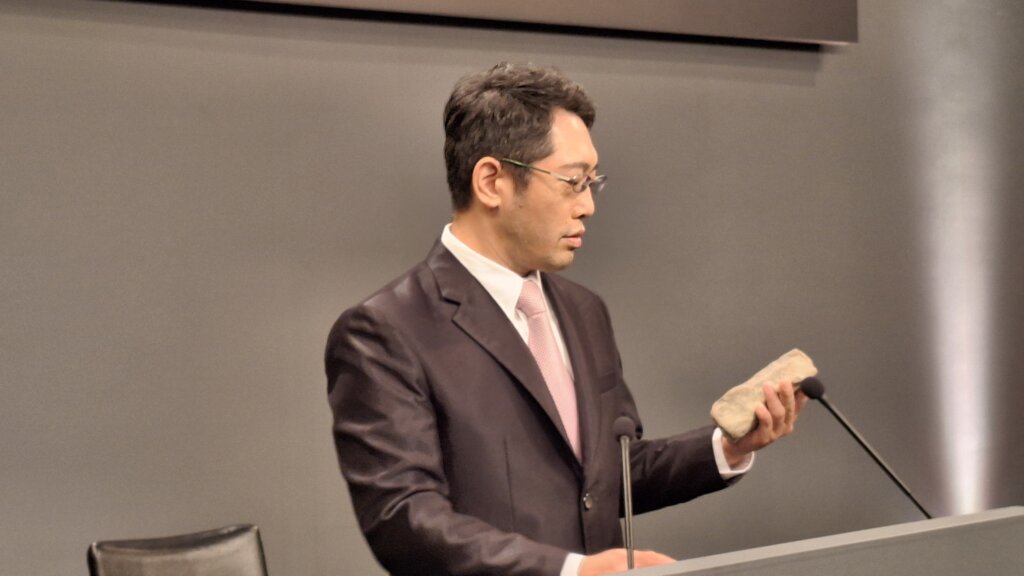
Dr. Wang Shou-cheng holds a rock specimen bearing fault striations on three surfaces. This marks the first time physical evidence of faulting has been presented at a nuclear referendum briefing. He urges the public to recognize that fault-related risks must be central to discussions of nuclear safety.
What is at stake
The prime consequence of passage would be that the vote could be cited as evidence of a “social consensus” for adoption of a “nuclear power” centered energy policy or a mandate to restart the Maanshan or Kuosheng nuclear power plants.
However, passage of this referendum cannot substitute for the professional and scientific safety review by the Nuclear Safety Commission or the decision by the Executive Yuan whether Maanshan is restarted nor find a final or even intermediate solution for spent nuclear fuel and other high-level radioactive waste.
Voting again and again cannot solve the problems of where spent nuclear fuel and other high level radioactive waste can be deposited, whether 40-year old nuclear reactors can really operate safely, whether the earthquake resistance measures for the Kuosheng (Nuclear Two) and Maanshan (Nuclear Three ) plans will be sufficient, or whether the government is capable of coping with a nuclear disaster.
Far more significant for the ultimate decision on the proposed restarts will be the results of January 2028 presidential and Legislative Yuan election.
However, in the light of the hype in the explanation that the referendum will “manifest the nearly 80% public will” to “demand that the government adjust the national development direction,” failure to pass, especially if “no” votes exceed “yes” votes, will send a signal that the majority of Taiwan citizens judge nuclear power to be unsuitable for our country and could lead to an end to calls to turn the clock back on the “nuclear free-homeland.”